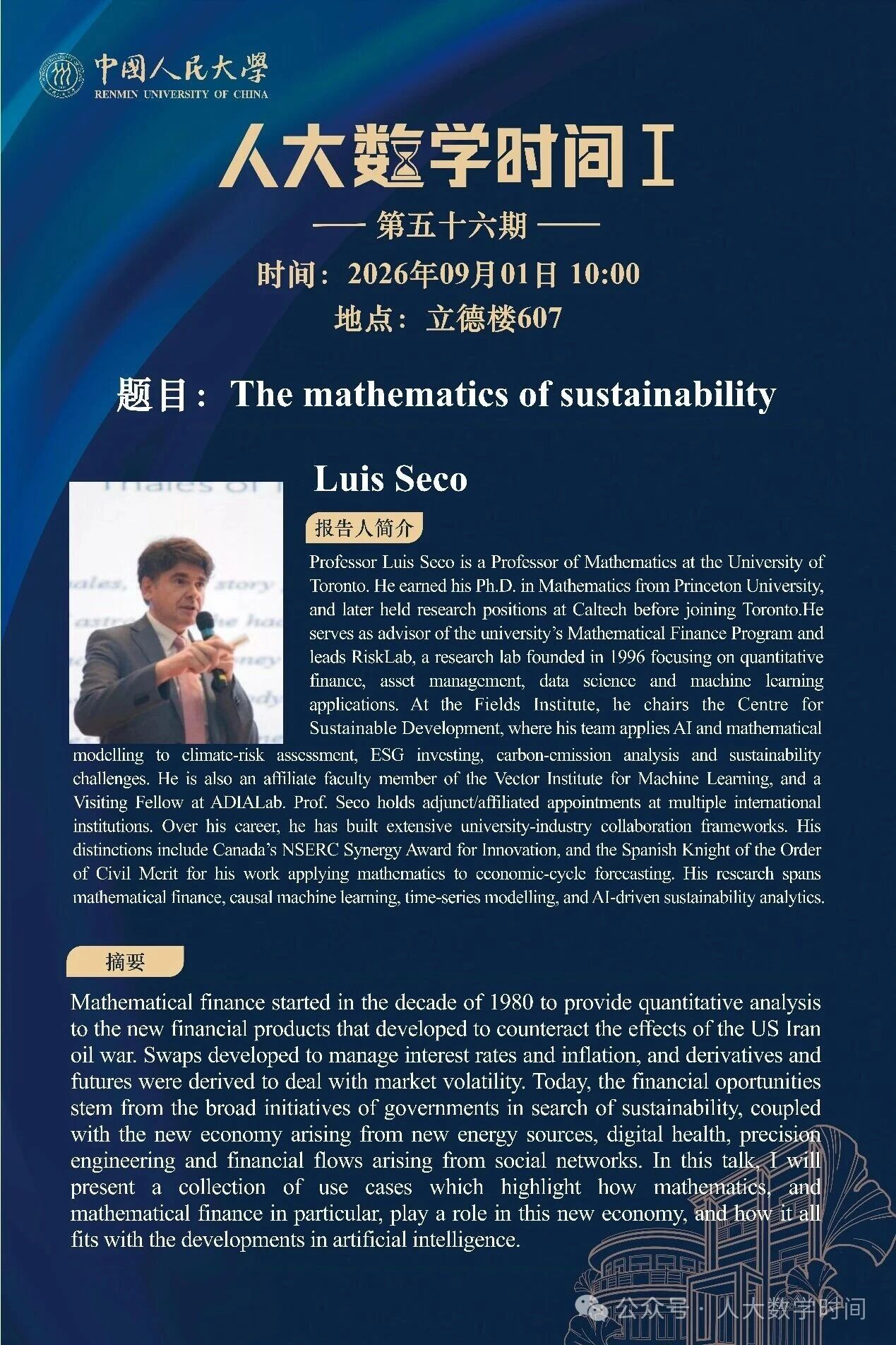
“人大数学时间I”第五十六期:Luis Seco
为促进学科交流融合、拓宽师生学术视野、释放科研创新活力,助力人大数学学科走向一流,做爱片 设立“人大数学时间”,以专题研讨、高端学术论坛为载体,搭建数学思想充分碰撞、优秀人才不断涌流、创造活力竞相迸发的舞台。“人大数学时间”将持之以恒,久久为功,立志通过交流与创新、提出重大问题,引领数学学科及相关领域的创新与发展,成为对我国数学发展有贡献意义的平台。以下为“人大数学时间I”第五十六期信息:
议程:
9月1日(星期二)10:00
Luis Seco教授报告及前沿问题探讨
地点:立德楼607
题目:The mathematics of sustainability
主讲专家:Luis Seco,多伦多大学数学系教授
摘要:
Mathematical finance started in the decade of 1980 to provide quantitative analysis to the new financial products that developed to counteract the effects of the US Iran oil war. Swaps developed to manage interest rates and inflation, and derivatives and futures were derived to deal with market volatility. Today, the financial oportunities stem from the broad initiatives of governments in search of sustainability, coupled with the new economy arising from new energy sources, digital health, precision engineering and financial flows arising from social networks. In this talk, I will present a collection of use cases which highlight how mathematics, and mathematical finance in particular, play a role in this new economy, and how it all fits with the developments in artificial intelligence.
报告人简介:
Professor Luis Seco is a Professor of Mathematics at the University of Toronto. He earned his Ph.D. in Mathematics from Princeton University, and later held research positions at Caltech before joining Toronto.He serves as advisor of the university’s Mathematical Finance Program and leads RiskLab, a research lab founded in 1996 focusing on quantitative finance, asset management, data science and machine learning applications. At the Fields Institute, he chairs the Centre for Sustainable Development, where his team applies AI and mathematical modelling to climate‑risk assessment, ESG investing, carbon‑emission analysis and sustainability challenges. He is also an affiliate faculty member of the Vector Institute for Machine Learning, and a Visiting Fellow at ADIALab. Prof. Seco holds adjunct/affiliated appointments at multiple international institutions. Over his career, he has built extensive university‑industry collaboration frameworks. His distinctions include Canada’s NSERC Synergy Award for Innovation, and the Spanish Knight of the Order of Civil Merit for his work applying mathematics to economic‑cycle forecasting. His research spans mathematical finance, causal machine learning, time‑series modelling, and AI‑driven sustainability analytics.